
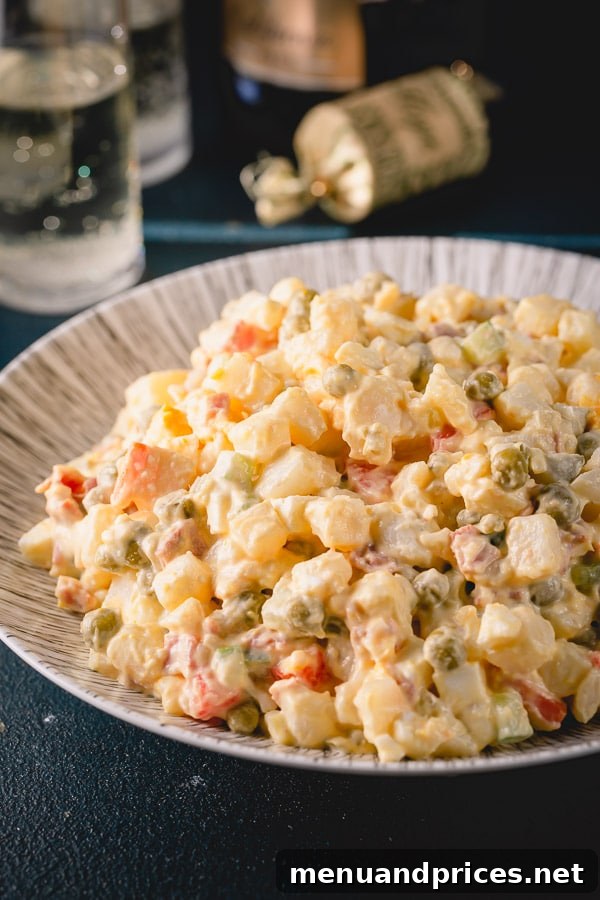
Embark on a culinary journey to the heart of traditional Eastern European and Slavic cuisine with the iconic Olivier Salad, often affectionately known as Russian Potato Salad or “Салат Оливье.” Far more than a mere side dish, this vibrant, creamy, and satisfying salad stands proudly as a meal in itself. Brimming with a delightful medley of tender vegetables, savory meats, and perfectly hard-boiled eggs, all lovingly enveloped in a rich, tangy mayonnaise dressing, Olivier Salad is a dish that promises both comfort and festivity in every generous spoonful.
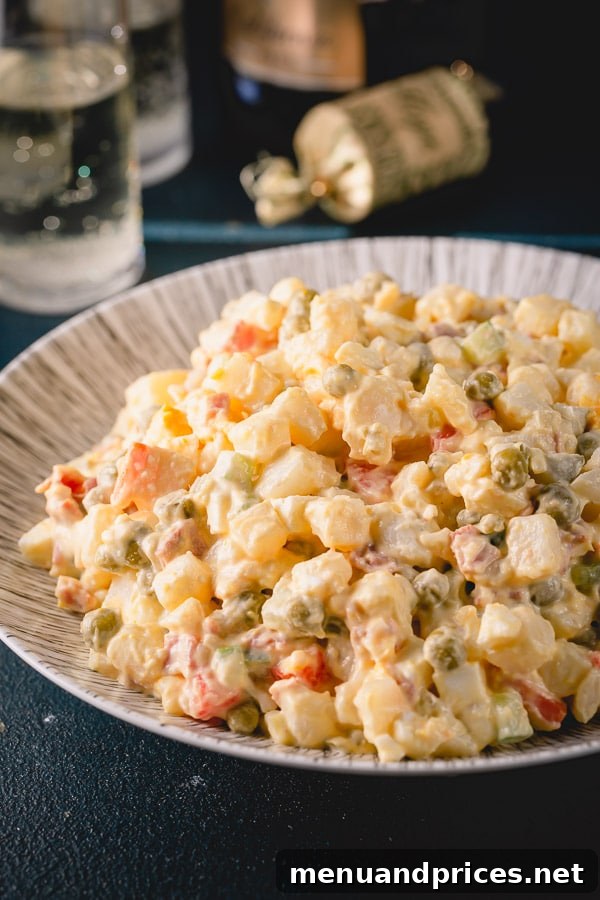
My connection to Olivier Salad runs deep, stemming from a childhood rich in cultural fusion. Though born and raised in Mongolia, my formative years were spent within a small, vibrant Russian community. It was inevitable that Russian cuisine would weave itself into the fabric of my early life, leaving an indelible mark on my palate and my heart.
One simply cannot envision Russian culinary traditions, especially during celebratory times, without the presence of Olivier Salad. This beloved dish isn’t exclusive to Russia; it’s a cherished staple across many Slavic nations. Given Mongolia’s significant historical and cultural ties to Russia, it’s no surprise that this creamy potato salad has also become incredibly popular in Mongolian households, a true testament to its universal appeal.
It holds a particularly revered place at every holiday dinner table, serving as the quintessential centerpiece for grand celebrations, most notably on New Year’s Eve. For many, including myself, the sight and taste of Olivier Salad evoke a profound sense of warmth, tradition, and joyous anticipation.
It is with immense excitement and a touch of nostalgic joy that I share with you my meticulously crafted version of this timeless Russian potato salad recipe. Prepare to create not just a dish, but a culinary memory that will be savored by all.
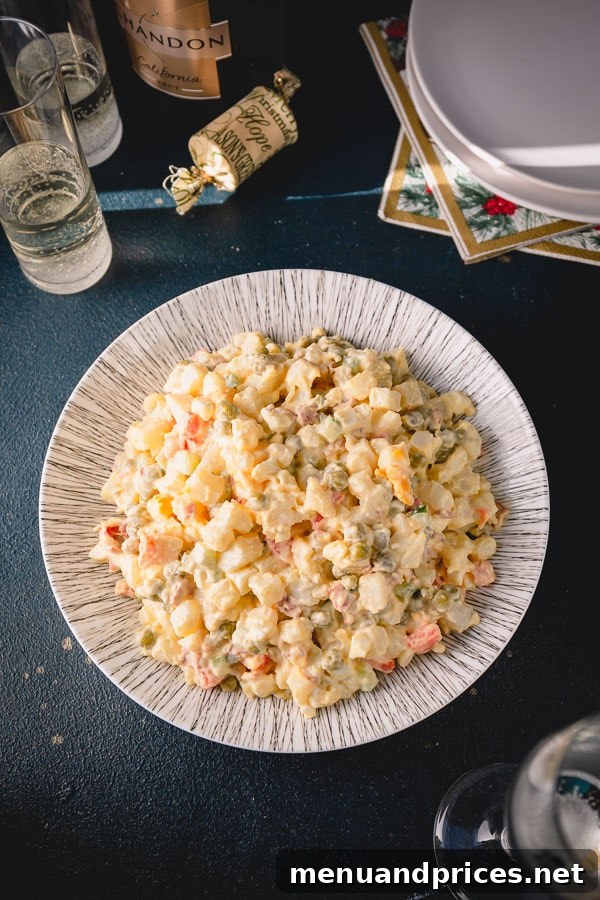
Understanding Olivier Salad: More Than Just Potatoes
Russian Potato Salad, universally recognized as Olivier Salad (or its original name, “Салат Оливье”), transcends the definition of a simple potato salad. It is, at its core, a robust and indulgent loaded potato salad, meticulously crafted with an array of complementary ingredients that elevate it into a complete culinary experience. The dish typically features a harmonious blend of tender, diced potatoes and carrots, sweet green peas, perfectly hard-boiled eggs, and a savory meat component—traditionally ham, bologna, or sometimes cooked chicken—all brought together by a creamy, rich mayonnaise dressing and brightened with fresh herbs.
The origins of Olivier Salad date back to the 1860s, created by Lucien Olivier, the chef of the Hermitage restaurant in Moscow. The original recipe was a closely guarded secret, said to include high-end ingredients like grouse, veal tongue, caviar, and capers, dressed with a secret mayonnaise. Over time, as the recipe spread and ingredients became more accessible, it evolved into the beloved, more democratic version we know today—a hearty and resourceful salad that became a symbol of Soviet-era abundance and festivity. It’s this adaptation, laden with accessible and flavorful components, that has cemented its place as a holiday tradition across Eastern Europe and beyond.
There isn’t a single, rigid “traditional” version of this salad; its beauty lies in its adaptability. Every family, region, and cook tends to have their own cherished variation, reflecting local tastes and available ingredients. This flexibility is what has allowed Olivier Salad to remain fresh and relevant for generations, continually reinventing itself while retaining its comforting essence.
- Some culinary traditions favor the use of bologna or a simple cooked sausage, while others opt for the smoky depth of smoked sausage or even tender shredded chicken.
- The choice of pickles also varies widely: some prefer the sharp tang of dill pickles, while others might incorporate fresh cucumbers for a lighter, crisper texture.
- Even the preparation of the vegetables sees different approaches: some cooks meticulously dice potatoes and carrots before cooking them, ensuring uniform tenderness, while others boil them whole and then dice, a method often seen as more traditional, albeit messier.
This inherent versatility is truly the salad’s charm. We encourage you to try the recipe as presented first, savoring its classic flavors, and then feel free to adjust it to perfectly suit your personal preferences and creativity.
- Not particularly fond of dill? Substitute with fresh parsley for a different herbaceous note.
- Craving an extra creamy texture? Simply add more mayonnaise until it reaches your desired consistency.
- For a milder onion flavor, swap out scallions for finely diced red onion or even shallots.
- Experiment with your favorite cured meats: explore different sausages, a good quality salami, or even leftover cooked chicken or turkey for a lighter twist.
The choice is entirely yours, allowing you to truly make this recipe your own. Personally, I find that the rich flavor and slightly firm texture of summer sausage add a wonderful depth to my potato salad, making it a truly satisfying experience.

Step-by-Step Guide: Preparing the Authentic Russian Potato Salad
Crafting a perfect Olivier Salad is a rewarding experience that combines simple techniques with thoughtful preparation. Follow these steps to create a salad that is both authentic and incredibly delicious.
Step 1: Preparing the Foundation & Cooking the Vegetables
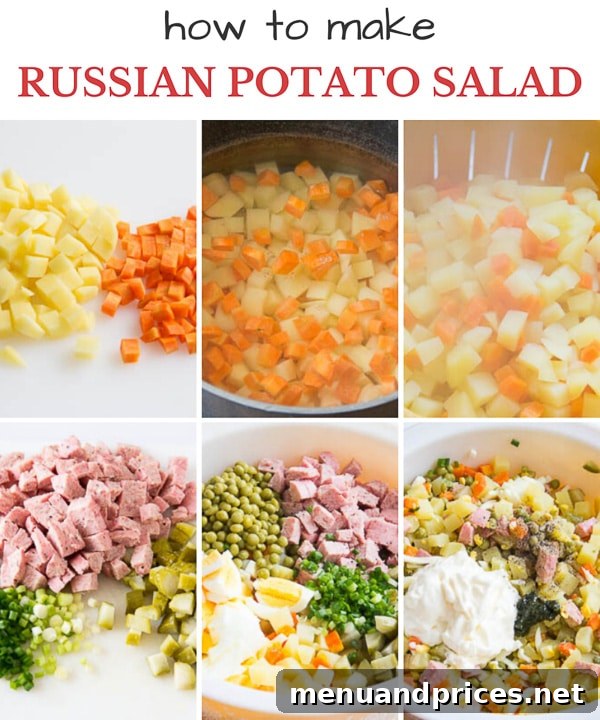
The foundation of a great Olivier Salad begins with perfectly cooked potatoes and carrots. For optimal texture and presentation, I highly recommend dicing your potatoes and carrots into small, uniform cubes *before* cooking them. This method ensures even cooking and avoids the frustration of trying to cut slippery, soft, cooked vegetables, which can often result in a sticky, uneven mess. Aim for pieces roughly the same size as your peas for a cohesive texture throughout the salad.
Prevent Mushy Potatoes: A Chef’s Secret
It’s all too easy to overcook diced potatoes, transforming them into an unappealing mush. To safeguard against this common pitfall and ensure your potato cubes maintain their perfect shape and tender-crisp texture, simply add half a tablespoon of white vinegar to the cooking water. The mild acidity of the vinegar helps to reinforce the potato’s cell walls, preventing them from breaking down excessively during boiling. Don’t worry, your vegetables won’t taste vinegary; this trick is purely for structural integrity!
Step 2: Achieving Perfectly Hard-Boiled Eggs
Hard-boiled eggs are a cornerstone of Olivier Salad, adding richness and a delightful texture. For consistent results, place eggs in a single layer in a saucepan, cover with about an inch of cold water, bring to a rolling boil, then remove from heat, cover, and let sit for 10-12 minutes. Immediately transfer them to an ice bath to stop the cooking process and make them easier to peel.
- If you find peeling cooked eggs to be a persistent challenge, consider exploring this genius trick for no-peel hard-boiled eggs! It’s a game-changer for many home cooks. Once peeled, dice them to match the size of your other ingredients.
Step 3: Preparing the Complementary Ingredients
While your potatoes and carrots are cooking and cooling, use this time efficiently to prepare the remaining ingredients. Finely chop your chosen onions (green onions or red onion), dice the sausage or other meat, slice your pickles, and mince any fresh herbs you plan to use. Ensure all components are cut into similar, bite-sized pieces to ensure an even distribution of flavor and a pleasant texture in every bite. Don’t forget to thoroughly drain your canned sweet peas.
Step 4: Assembling and Mixing for Flavor Harmony
Now comes the most satisfying part: bringing all the wonderful components together. In a large mixing bowl, gently combine the cooled potatoes and carrots, diced hard-boiled eggs, chopped onions, sausage, pickles, and drained sweet peas. Add your mayonnaise and dill paste (or fresh dill) and mix everything thoroughly but gently, ensuring all ingredients are evenly coated without mashing the potatoes. Season generously with salt and freshly ground black pepper to taste. A good seasoning is crucial for enhancing all the individual flavors within the salad. Cover the bowl with plastic wrap and refrigerate for at least 1 hour, or ideally longer, before serving.
While the temptation to serve this exquisite potato salad immediately might be strong, I cannot emphasize enough the transformative power of chilling. Allowing the salad to chill in the refrigerator for at least an hour—and even better, several hours or overnight—permits all the distinct flavors to meld and deepen, resulting in a far more harmonious and delicious experience. This crucial resting period makes it an absolutely perfect make-ahead salad, ideal for entertaining or for simply enjoying over several days.
I genuinely adore this Olivier Salad! Every time I prepare it, it instantly transports me back to the warm, comforting memories of my childhood and infuses our home with a distinct holiday spirit. The blend of textures and tastes is simply irresistible, a true celebration in a bowl.
My usual practice is to prepare a generous batch, allowing me to relish bowlfuls of this delightful creation for several days. It stores exceptionally well in the refrigerator, and, quite remarkably, the flavors tend to intensify and become even more profound the longer it sits. This makes it a fantastic option for meal prepping or for ensuring you have a delicious, ready-to-eat dish on hand.
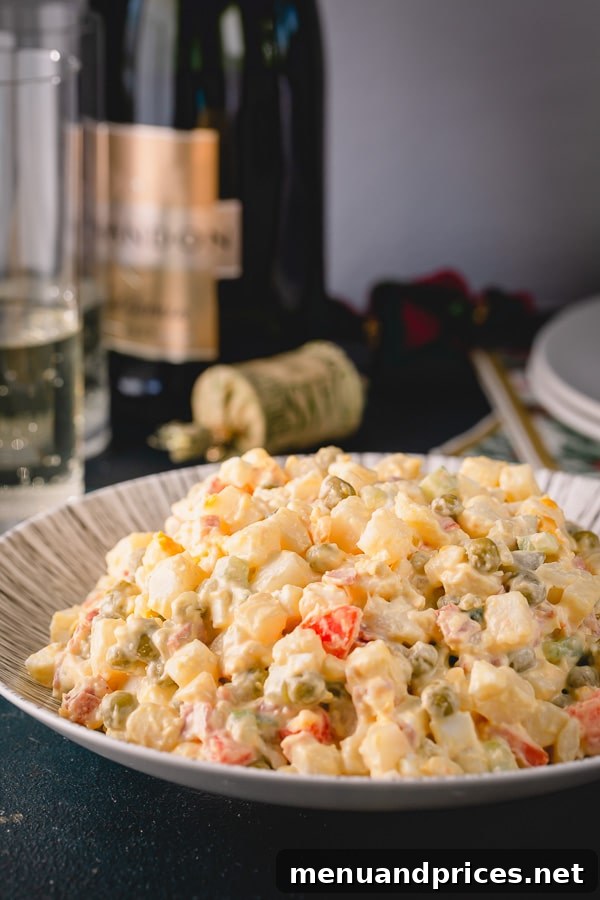
Russian Potato Salad (Салат Оливье)
Pin Recipe
Comment
Print Recipe
Ingredients
- 4 medium potatoes washed and peeled, if desired (2lbs/900g)
- 3 medium carrots washed and peeled (10oz/300g)
- 1 tablespoon table salt
- ½ tablespoon white vinegar Note 1
- 4 hard-boiled eggs Note 2
- 7 oz (200 g) summer sausage Note 3
- 4 oz (100 g) dill pickles
- 1 (15oz) can sweet peas drained
- 1 teaspoon dill paste or fresh dill
- 4-5 green onions Note 4
- 1 cup mayo
- Salt and pepper to taste
Instructions
-
Cut the potatoes and carrots into small, uniform cubes, approximately the size of your peas.
-
Place the diced potatoes and carrots into a large pot and cover with enough cold water.
-
Add the table salt and white vinegar to the water. Bring the pot to a boil over medium-high heat, then reduce the heat to medium and continue to cook until the potatoes are tender but still hold their shape, typically about 15 minutes. Drain the cooked vegetables thoroughly and allow them to cool completely to room temperature.
-
While the potatoes and carrots are cooling, proceed with preparing the other ingredients. Dice the summer sausage (or your chosen meat) and pickles into small, consistent cubes. Finely chop the green onions.
-
Once your hard-boiled eggs have cooled and been peeled, cut them into small cubes, matching the size of your other diced ingredients.
-
If using fresh dill instead of dill paste, finely chop the fresh dill now.
-
In a very large mixing bowl, combine the cooled potatoes, carrots, diced hard-boiled eggs, sausage, pickles, drained sweet peas, and chopped green onions.
-
Add the mayonnaise and dill (paste or fresh) to the bowl. Gently mix all the ingredients until they are thoroughly combined and evenly coated with the dressing. Be careful not to mash the potatoes.
-
Taste the salad and adjust seasoning with salt and pepper as needed. Cover the bowl tightly with plastic wrap and refrigerate for at least 1 hour before serving. Chilling allows the flavors to meld beautifully.
⭐️ Did you make this recipe?
Please leave a review and let us know how you liked it!
Tips & Notes
Note 2: For effortlessly diced eggs, I find an egg slicer like this to be incredibly useful. However, if you prefer to avoid the task of peeling hard-boiled eggs altogether, this genius trick for no-peel eggs would be perfect for you!
Note 3: While summer sausage is my personal preference for its rich flavor and texture, you can easily substitute it with bologna, any type of smoked sausage, or even shredded cooked chicken for a different profile.
Note 4: If green onions aren’t readily available or you prefer a different onion flavor, finely diced regular yellow onion or delicate shallots can be used as excellent alternatives.
Nutrition

This recipe was originally published on December 24, 2014, and has been updated to provide a more comprehensive guide to this cherished classic.